

Moisture control is one of those things that only gets attention once there is black mould in the corner of a bathroom ceiling. Chilvers Electrical recently completed a loft installation of a 6-inch Vent-Axia CM in-line fan, fitted to give a Milton Keynes home the extraction rate it actually needed.
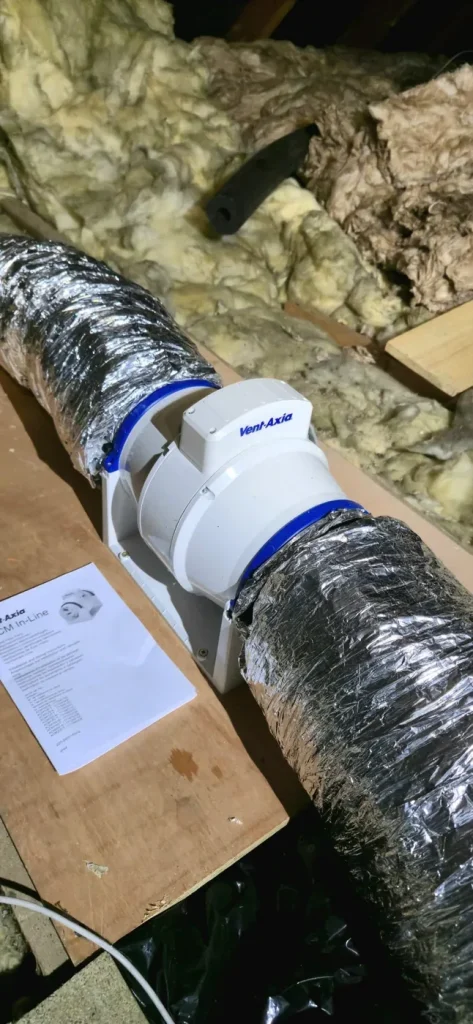
Why an in-line fan rather than a wall fan
A standard axial fan sits in the wall or ceiling of the room and works over a short duct run. Push it down a long duct, round bends, and up into a loft, and its performance collapses — it simply cannot move air against that resistance. An in-line fan sits in the duct run itself and is built to work against that resistance, which is why it is the right choice where the outlet is a long way from the room.
Mounting it in the loft has a second benefit: the noise goes with it. The fan is the noisy part, and moving it out of the ceiling void above the bathroom and into the roof space makes a noticeable difference to how the room feels to use.
Ducting is where installations fail
Fitting the fan is the straightforward half. The ducting is where most installations quietly fail.
We used foil-wrapped insulated flexible ducting for the run. In an unheated loft, warm wet air from a bathroom hits cold duct walls and condenses. Uninsulated ducting turns into a pipe full of water that drips back down into the fan or the ceiling, and the homeowner ends up with a damp patch and no idea why. Insulated ducting keeps the air above the point where it condenses.
The other rules matter just as much: keep the run as short and straight as possible, support it so it cannot sag into a low point where water collects, avoid crushing the flexible ducting round bends, and terminate it properly at the outside — never into the loft void itself.
The fan was installed to the manufacturer’s instructions and to current UK electrical regulations, then tested before handover.
If you need ventilation improving in Newport Pagnell, Milton Keynes or the surrounding areas, get in touch with Chilvers Electrical.